
For a long stay, compare the full 90-day cost, local identity requirements, hotspot limits and renewal process. A short travel eSIM is useful for arrival, while a local account or longer-validity plan may be better after residence arrangements are in place.
Separate arrival-week needs from semester needs
You may need immediate maps, student housing messages and university sign-in during the first three days, while the later semester involves scheduled classes, transport apps and a local contact number. A data-only arrival eSIM can be helpful even if you ultimately buy a local subscription. Budget these phases separately instead of forcing one product to cover everything.
Compare realistic total cost and flexibility
A 30-day pass bought three times has a different risk and cost profile from a 90-day valid plan, a local prepaid SIM or a rolling monthly subscription. Add top-ups, taxes, activation fees, local registration requirements and cancellation terms. Avoid assuming a “month” always means 30 days or that unused allowance survives renewal.
Account for classes and working style
Video lectures and laptop hotspot sessions can use substantially more data than messaging and occasional maps. Estimate use over an entire week including software updates, and prefer campus Wi-Fi for large transfers. For remote exams or critical calls, keep a tested alternative connection where possible.
Local phone identity may still matter
A university, landlord or bank may require a local number, whereas a data-only travel eSIM may not provide voice or SMS. Research identification requirements and local operator policies before arrival. Keep your home number safe for existing account recovery while checking what its continued roaming access costs.
A simple four-phase semester model
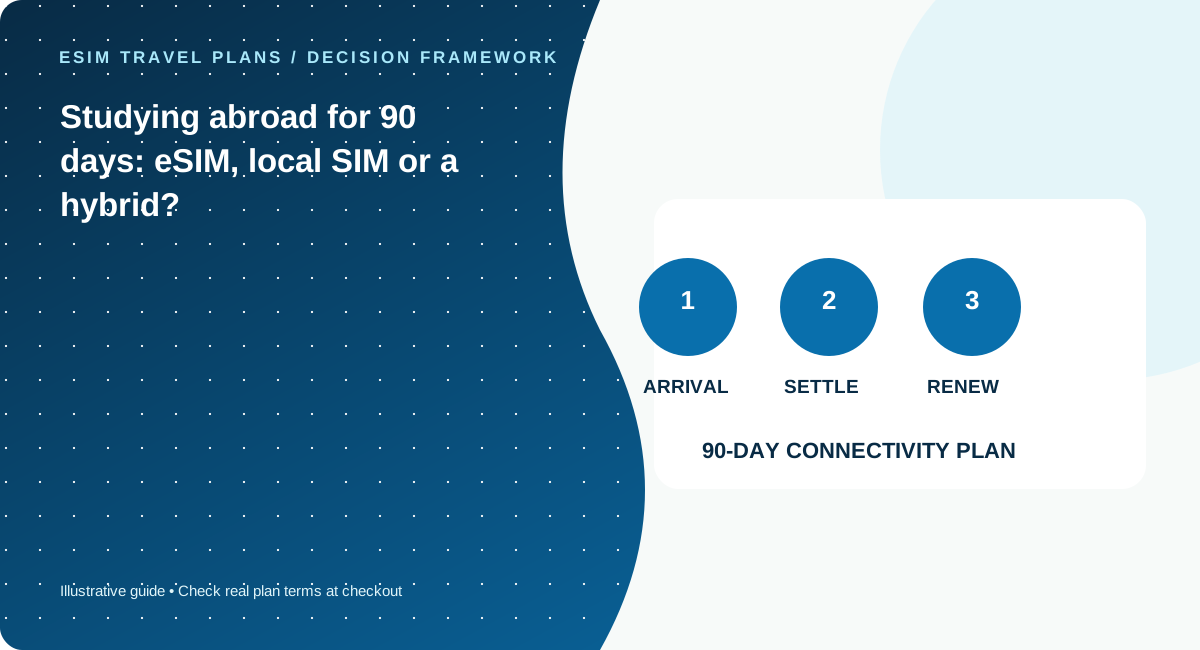
Phase one is airport-to-campus connectivity for the first days. A short data plan can cover accommodation searches and maps while you arrange a longer solution. Phase two is registration: universities, banks and landlords may have number or identity requirements, meaning a local SIM with voice/SMS can be more useful than a cheaper data-only profile. Phase three is regular study: identify the number of lectures, meetings, commutes, weekend trips and hotspot sessions you actually expect. Phase four is departure or renewal, where unexpected subscriptions and unneeded top-ups can create costs. Compare options across these phases rather than treating 90 days as one uniform bundle. Consider whether the local plan’s price includes a reliable means of identity verification. Retain control of the old number if it is tied to important accounts, and budget its roaming charges separately.
How to decide between a travel profile and local service
Make a table with columns for 90-day total cost, data allowance, expiry behavior, top-up process, hotspot rules, local calls/SMS, customer-service access and cancellation. A travel eSIM may win on immediate arrival convenience or short cross-border trips; a local prepaid service may win for repeated use and local identity; a hybrid can be appropriate when you need both. The winner is conditional on the exact country and product, so avoid blanket claims that local SIMs are always cheaper or that travel eSIMs are automatically the modern replacement. If an offer is described as “unlimited,” record whether the full-speed entitlement is daily, total or restricted for tethering. For coursework, use campus Wi-Fi for heavy downloads and keep spare mobile data for critical classes.
Five checks before you pay
- Split arrival-week from ongoing semester connectivity
- Compare three renewals against a longer plan
- Confirm SMS/voice requirements for university and banking
- Budget laptop and video lecture data separately
- Plan cancellation and next-country travel
Common mistakes to avoid
- Travel eSIM data may not include a local number
- A 30-day plan is not a three-month entitlement
- Large software updates can exhaust small bundles
Work with your real itinerary or quotes
Use our free in-browser calculator, then verify live plan stock, exact destination coverage and final charges directly with TripoSIM.
Commercial disclosure: we are owned by BroadNet and promote TripoSIM. No specific retail SKU or guaranteed price is represented here.
Source notes and review standard
This page is educational editorial analysis dated 5 November 2026. It does not claim field measurements, current retailer inventory, exclusive third-party quotes or verified network speeds. Confirm the exact product terms and local phone configuration before paying.
Additional context: our research methodology and editorial standards.
Continue reading
Japan, Korea and Taiwan eSIM itinerary: one trip, three network checks
A practical three-stop route worksheet for travelers who cannot afford to discover a coverage gap at the next airport.
Travel eSIM with your normal number: a two-line arrival guide
Use a travel data line without accidentally moving calls, SMS verification or roaming data onto the wrong SIM.