
An individual travel eSIM is convenient when each phone needs independent access, while pocket Wi-Fi can serve several devices if hotspot and battery conditions are acceptable. The better option depends on how frequently the travelers separate and whether either person needs connectivity when the shared router is elsewhere.
Who is this for?
Imagine two travelers spending ten days in Tokyo, Kyoto and Osaka. They ride different trains for an afternoon, use separate translation apps and book last-minute transport. A single portable router cannot connect both people when they are separated. Two compatible phone eSIMs can offer independent access, subject to the actual local coverage of each plan.
How to compare the available choices
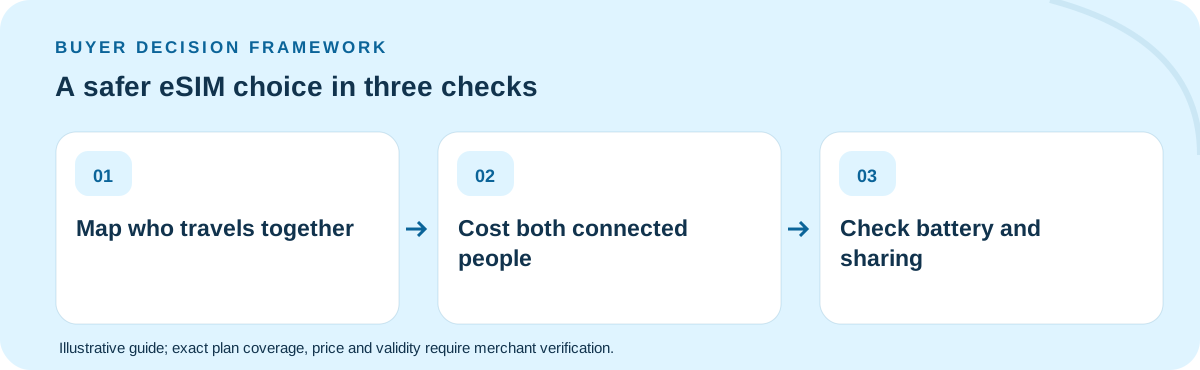
Compare end-to-end scenarios rather than headline device count. For pocket Wi-Fi, consider rental period, pickup, return, security deposit, possible delivery, battery charging and the cost of losing the unit. For eSIMs, consider separate handsets, data allocations, network coverage, tethering rights and the installation work required before arrival.
What to do before departure or purchase
The deciding questions are operational: will you split up, can both phones install eSIMs, do you need laptop tethering, and is a spare battery realistic? A shared router may suit a couple moving together with several devices. Independent eSIMs may suit split itineraries and emergency contact, although the final combined price could be higher or lower.
Worked example with explicit assumptions
In a hypothetical comparison, a pocket router costs $7 per day for ten days plus a $9 collection fee, totaling $79 before damage charges. Two eligible travel eSIMs cost $24 each, totaling $48. These values illustrate the arithmetic only; they are not current Japan market quotes. Verify real retailer prices, fees and permitted devices before buying.
Common mistakes to avoid
The most expensive mistake is to compare one eSIM against a router serving two phones and a laptop without accounting for actual people and equipment. Another is assuming network performance is guaranteed at every train stop. Offline transit tickets and downloaded city maps protect both options when coverage is weak.
What would change the answer?
There is a fourth option worth evaluating: one phone with a travel eSIM and allowed tethering. It can be cheap, but the host phone and the other traveler must stay physically close, and battery capacity becomes shared infrastructure. On a split museum day, that dependence may be a worse inconvenience than paying for an independent line. Compare the price of two connected people, not merely one connected object.
Five-item decision worksheet
| Check | What to verify |
|---|---|
| Eligibility | Confirm the exact device, activation method and covered destination(s) against the retail product, not a country-average study. |
| Validity | Work backward from the situation described in this guide: Imagine two travelers spending ten days in Tokyo, Kyoto and Osaka. Check when the clock starts and the last active day. |
| Usage | Estimate the full-speed GB or communication capabilities this particular itinerary needs; include hotspots, essential apps and an emergency buffer. |
| Economics | Compare current final payable totals only among options that meet every requirement; treat any arithmetic example here as hypothetical. |
| Fallback | Before departure, consider this failure mode: The most expensive mistake is to compare one eSIM against a router serving two phones and a laptop without accounting for actual people and equipment. Keep the seller’s support instructions available offline. |
Which option should you buy?
Buy based on how your party travels, not what a product category claims. If you separate frequently, prioritize independent lines. If you remain together, test the router economics with every cost included, then compare live TripoSIM Japan offers at checkout.
Can two people share one travel eSIM?
An eSIM is normally installed on one device. Sharing internet through a phone hotspot may be possible when the purchased plan and device permit tethering; independent lines require separate compatible profiles.
Primary technical/regulatory reference: official guidance for this topic. This source provides background, not a verification of any live TripoSIM SKU. The scenarios, prices and quantities in this guide are illustrations, not tested carrier offers. Every product's eligibility, data, voice, coverage, activation, fair use and current final price must be checked with the seller before purchase.
Ownership: This website is commercially affiliated with TripoSIM. It does not claim independent testing, neutrality or live catalog pricing. See research methodology.